

Please join The Policy Circle on this Tuesday, April 9th for a Conversation Call to discuss “A Closer Look at Socialism: Venezuela, A Case Study” .
This is the final post in a series taking an in-depth look at Venezuela’s past and present social, political, and economic troubles, the role socialist leaders and their policies played, and how this relates to current conversations within our own government. Understanding the history of such an evolution is crucial in preventing similar problems from reaching other shores, including our own.
If you missed the previous posts on Venezuela, you can click on the image below to read the full series.
The Series | A Closer Look at Socialism: Venezuela, A Case Study

The Path Forward
Hardly a day goes by without a new report on Venezuela, with daily developments from the Maduro regime, attacks on opposition leader Juan Guaidó, new sanctions imposed by the United States, and fresh reactions from the international community. What is really happening and what does the path forward look like?
“Free and Fair Elections”
Suspicious activity surrounded the 2018 Venezuelan presidential election. In early 2018, incumbent President Maduro announced that presidential elections, which are traditionally held in December, would be moved up to April. They were then rescheduled for May, reportedly to coincide with elections for the State Legislative Council and Municipal Councils. Opposition members refute this reasoning and instead claim the calendar change was to prevent them from having another 8 months to organize (NY Times). Maduro spent the months leading up to the election blocking opposition parties from participating or campaigning, including the Mesa de la Unidad Democrática and Primero Justicia parties, and arresting opposition candidates, such as former Interior Minister and candidate Miguel Rodriguez Torres. Maduro also announced that all eligible Venezuelans must vote on election day or face sanctions, despite the fact the Constitution declares voting to be a voluntary act (Atlantic Council).
The government used a number of tactics to intimidate and influence voters; government-financed militias repeatedly interrupted opposition marches and many government employees reported they were pressured to vote for Maduro and his legislative candidates. One employee from the international airport in Maracaibo claimed his employer demanded the staff vote for Maduro’s candidates and present a photo of their ballots as proof (The Atlantic).
Additionally, after voting, many people visited “Red Spots,” which were pro-government booths where they could present their special identity cards, receive government subsidized food boxes, and give “their names to workers who were keeping lists of those who had voted.” Although workers claimed there was “no effort to pressure voters or link a pro-Maduro vote to future food deliveries,” many were cautious. One woman said, “she felt compelled to vote for Mr. Maduro” and feared she would lose her government job if she did not vote and give her name at the Red Spot (NY Times).
The results revealed that Maduro had received 5.8 million votes. His main rival Henri Falcón, who ran even though his fellow opposition members called for an election boycott, received 1.8 million votes. For comparison, Maduro received 7.5 million votes in the 2013 election after Chavez’s death (The Guardian). Maduro declared himself victorious in May 2018, but not everyone agreed; the organization Observación Ciudadana (Citizen Observation) denounced the results, listing cases of coercion and intimidation, such as government control stops at polling stations. Even without these accusations, the results were disputed as only 46 percent of Venezuelans participated on election day (NY Times, Atlantic Council). For the 3 previous presidential elections in 2006, 2012, and 2013, between 70 and 80 percent of the population voted (Election Guide).
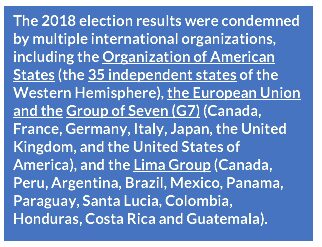
To understand more about how Venezuela’s 2018 elections violated Venezuelan Law and internationally recognized standards, take a look at this infographic.
Opposition Uprising
Despite the international community’s condemnation of the 2018 elections, Maduro kicked off his next six year term with an inauguration ceremony on January 10, 2019. Barely two weeks later, mass protests and demonstrations broke out in Caracas in support of Juan Guaidó, the president of the National Assembly, who swore himself in as interim president on January 23, 2019, per the Venezuelan Constitution.
Guaidó became head of the opposition-held congress, the National Assembly, in early January. Since the presidential election results are contested, Guaidó claims Maduro is usurping the presidency by continuing to stay in office. Therefore, Guaidó would become interim president based on Article 233 of the Venezuelan Constitution: “If at the outset of a new term there is no elected head of state, power is vested in the president of the National Assembly until free and transparent elections take place” (NY Times).
Pressure from Abroad
Most of Europe called for re-elections by January 26, and Spain, Britain, France, and Germany endorsed Guaidó after Maduro refused to hold elections again. At the end of January, European Union lawmakers voted 439 in favor to 104 against (with 88 abstentions) to recognize Guaidó until “new free, transparent and credible presidential elections” take place. The EU parliament has no foreign policy powers, but does have symbolic importance, especially in the realm of human rights. By February, most Latin American and European nations had given their support to Guaidó, were considering imposing sanctions, and were calling for free and fair elections in Venezuela
On January 23rd, the United States led the way by recognizing Guaidó as the leader of Venezuela, which prompted a series of new U.S. sanctions against the Maduro regime. Venezuela sends over 40 percent of its oil to the United States and is one of the United States’ top 4 crude oil suppliers. Specifically, tension has surrounded Citgo, a wholly-owned subsidiary of Venezuela’s PDVSA operating in the U.S. Citgo manages three refineries in the U.S. and amounts to about 4 percent of U.S. fuel. The Citgo business relationship has been strained, especially after Treasury Secretary Steven Mnuchin announced that the proceeds of Venezuelan oil would be withheld from the Maduro government and would instead be deposited in a blocked account (BBC). In February, Guaidó took over administration of Citgo, based on the “general license issued by the Treasury Department’s Office of Foreign Assets Control” (Bloomberg).
Maduro responded in kind. After the US recognized Guaidó, Maduro severed diplomatic relations with the United States, and all non-essential personnel were pulled from the embassy (The Guardian). All other staff members withdrew from the American Embassy during Venezuela’s extensive power outages, when Washington was “unable to obtain an extension of security guarantees from the Maduro regime” (WSJ). In early March, the Maduro administration accused German ambassador Daniel Kriener and the German government of “repeated acts of interference in the country’s internal affairs.” The German government is one of the many that supports the opposition, and Kriener was present at the airport when Guaidó returned to Venezuela from a trip abroad. Kriener was among a group of diplomats from eleven Latin American and European nations who greeted Guaidó, but so far has been the only one targeted (The Guardian, BBC).
For more on the tense relationship between the United States and Venezuela and how it’s affecting conditions right now, check out this NY Times podcast on the humanitarian aid debacle in February or this BBC video about the role of oil in the US-Venezuela relationship.
International Allies
Over 50 countries support Guaidó, but Mexico, Turkey, Bolivia, El Salvador, and Nicaragua continue to recognize the Maduro regime (NPR, CFR). China has also expressed support for Maduro, most recently offering technical assistance to Venezuela to help restore the country’s electrical grid. Additionally, China and Russia vetoed a United Nations Security Council vote in February to condemn the May 2018 elections and call for international humanitarian aid for Venezuela (WSJ).
Russia and Venezuela have a long history and remain entangled in the oil industry. Since 2015, Rosneft, the Russian state-controlled oil firm, has increased its loans to Venezuela and its shareholder stakes in a joint venture with PDVSA. All other international oil companies have left the country or frozen their investments, including Lukoil, Russia’s second biggest firm. A Reuters investigation uncovered documents revealing that equipment is scarce, oil output is far lower than projected, and there is a “$700 million hole in the balance sheet of the joint venture.” However, Venezuela buys Russian weapons, which gives Russia an incentive to stand by its ally and even provide military support.
Cuba is also heavily involved with Venezuela’s oil industry, and relies on Venezuela for almost one-third of its oil needs. In the early 2000s, Cuban leader Fidel Castro signed a deal with Hugo Chavez to provide Cuba with crude oil in exchange for Cuban professional staff such as teachers and doctors, as well as intelligence and security agents, to go to Venezuela. The opposition has criticized this longstanding agreement and is expected to stop oil shipments if it gains power. Even though Venezuela’s oil production has collapsed and Cuba gets far less oil than the agreement states, Cuba’s reliance on Venezuelan oil and the countries’ long-standing allegiances to one another are incentives to support the Maduro regime (WSJ).
The Future for Venezuela
At present, there is political stalemate in Caracas. Most of the international community and large portions of the Venezuelan population support Guaidó and the opposition party, and the UN High Commissioner for Human Rights has accused the Maduro administration of human rights violations. But the Maduro regime has the backing of the military and still has not stepped down. In mid-March, Robert Marrero, Guaidó’s chief of staff, was taken into custody after police raided his apartment. Maduro’s government has since banned Guaidó “from holding public office for 15 years” and in the first week in April stripped Guaidó of immunity, “paving the way for the opposition leader’s prosecution and potential arrest” (Associated Press).
The Maduro administration also still has control of major industries including oil and gas, electricity, finance, and telecommunications. One student activist expressed concern recently during the blackouts that many would believe Maduro’s claims of international sabotage “because the blackout had knocked out communication systems across the country, giving his administration a monopoly on information” (The Guardian).
President Trump and National Security Advisor John Bolton have not ruled out military interventions in Venezuela, although the United States’ long history of interfering in Latin American political affairs has not earned it much favor. Venezuela’s opposition has called upon the international community to consider the use of force, but most members of Congress and top Trump administration officials maintain that military action is not likely, Military action is heavily opposed by Canada and European and Latin American governments (WSJ). There is also concern that any military intervention would result in years of “messy work of keeping the peace and rebuilding institutions” (Foreign Affairs).
In February, the European Union and several Latin American countries developed the multilateral International Contact Group to work with international partners to deliver humanitarian aid and start negotiations for free and fair elections between the Maduro government and the opposition. In March, Elliott Abrams, the US Special Representative for Venezuela, met with Russian Deputy Foreign Minister Sergei Ryabkov in Rome to discuss the situation in Venezuela, but the two were not able to come to an agreement on any plan of action (Associated Press).
For now, “the U.S. is continuing to vocally support Mr. Guaidó, revoke U.S. visas for Venezuelans linked to Mr. Maduro and build up aid supplies across Venezuela’s borders in Brazil and Colombia.” The Trump administration, in the midst of a crackdown on deportations and disputes over increased border security, is also debating how to address Venezuelan immigrants seeking refuge in the United States. Abrams “advocates granting special immigration status for Venezuelans residing illegally in the US” and a group of 24 senators signed a bipartisan letter calling for TPS (Temporary Protected Status) for Venezuelans (WSJ).
Meanwhile, Venezuela’s lack of food, medicine, and basic necessities shows no signs of improving. Power outages still plague the country, and because of hyperinflation, the American dollar is now has more purchasing power in Venezuela than the country’s own currency. As governments and factions compete for power, the people of Venezuela continue to suffer.
Lessons Learned
“Chavez’s so-called Bolivarian revolution took a peaceful, middle-income country and transformed it into a nightmare that puts the ruinous Soviet Union of the 1980s to shame” – Noah Smith, Bloomberg

The media have assigned blame for Venezuela’s humanitarian crisis, citing causes from falling oil prices to international sanctions. In reality, Saudi Arabia, Nigeria, and Kuwait are just some of the world’s petrostates that also saw their incomes fall when oil prices dropped but emerged from recession with their economies intact. Additionally, although President Maduro has blamed the United States and its imposed sanctions, none of these sanctions were broad enough to inflict the type of damage Venezuela is currently suffering. Venezuela cannot contribute its crisis situation to anything but the “self-inflicted catastrophes of socialism” (Bloomberg).
What separates Venezuela from similar nations is its history of centralizing power and government overreach, and its inability to “stabilise external and fiscal accounts” (Financial Times). By imposing price controls, expropriating private property, and conducting large-scale industry nationalization, the Venezuelan government overstretched its boundaries. President Chavez went on a nationalization spree in the 2000s that pushed out all private enterprise, starved industries of technical expertise and investment, sent government-controlled institutions into a downward spiral, and made Venezuela one of the worst countries in which to do business in 2019.
The “dismantling of democratic checks and balances, and sheer incompetence” that resulted from these decisions led Venezuela to collapse. Now, “repressive violence is the final thing left that Venezuelans can rely on the public sector to consistently deliver” (Foreign Affairs).
In its “relentless class warfare and government intervention in the economy,” the Chavez-Maduro authoritarian regime destroyed the country. Maintaining basic freedoms and remaining committed “to the rule of law, limited government, and checks and balances” is what separates true democratic nations from Venezuela, and what the rest of the world must remember to adhere to (Foundation for Economic Education).
What can you do?
- Be in the know on Venezuela issues and share with your friends, colleagues and family:
- If you missed them, you can read the first , second, and third posts in this Venezuela series
- Check out this Policy Circle Brief on Free Enterprise for more on markets and how they are affected by government interference
- Consider participating in the Policy Circle’s Conversation Call about Venezuela
- Keep track of bills in Congress related to Venezuela
- For more on Venezuela’s crisis and government overreach, watch this Prager U video or listen to this NPR podcast.
- Engage
- Know who decides policy in Venezuela: Stay up to date with information from the House Foreign Affairs Committee and the Senate Committee on Foreign Relations
- Invite your elected officials to talk to your circle, or organize a community gathering about aid, policy, and what your tax dollars are going to support in foreign countries.
- Pose any questions in a written piece for your local publication to make others in your community aware and seek answers. Check out the Policy Circle’s guide to writing an Op-Ed.
Please join The Policy Circle on April 9th for a Conversation Call to discuss “A Closer Look at Socialism: Venezuela, A Case Study” (details provided through the link).




The Policy Circle is a 501(c)3 that provides a fact-based, nonpartisan framework built to inspire women living in the same community to connect, learn about and discuss economic policies that impact their lives. Women across the nation are taking a leadership role in the public policy dialogue on what human creativity can accomplish in an open economy.


