
The Active Voter Guide
Your voice and your vote matter in every election. Every American citizen has a duty to actively participate in the election process. The first step i…
Read

POLICY INSIGHT
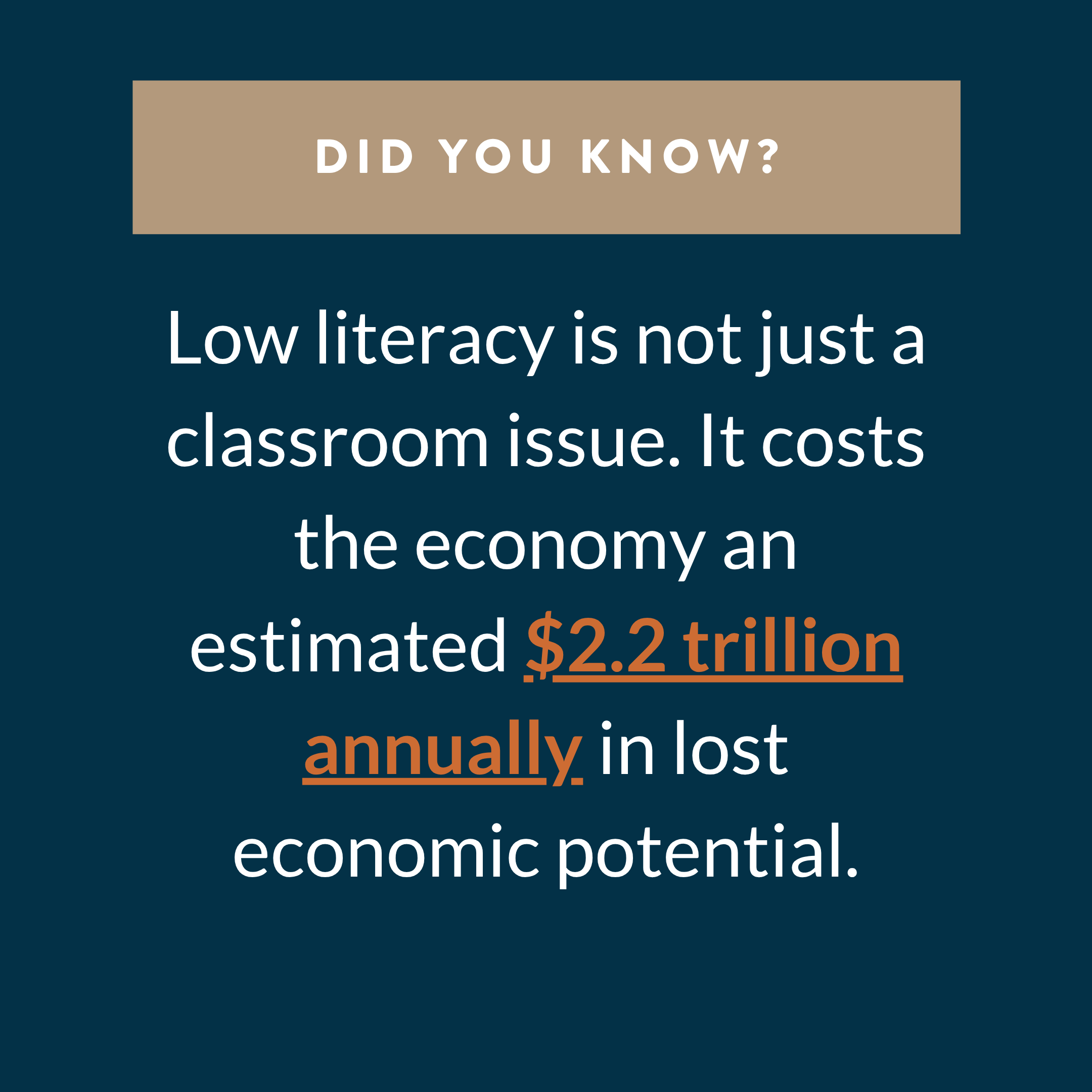 Literacy rates in the U.S. have declined for decades, with serious consequences for learning and opportunity. The National Assessment of Educational Progress (NAEP) shows that 33% of fourth graders and 29% of eighth graders read at a “proficient” level. 37% of 4th graders scored below “basic” in reading, a near-record high, and more than half of U.S. adults read below a sixth-grade level.
At the same time, nearly 40% of college students drop out before completing their degree. For years, “college-for-all” was the guiding principle, yet today the country faces a shortage of skilled trade workers, jobs that remain essential even as AI disrupts white-collar professions. The education system is not only failing to meet literacy benchmarks but is also misaligned with future workforce needs. We are at a crossroads. With the rise of AI as a transformative technology, the critical question is whether it will reinforce outdated systems or spark a reimagining of how and what students learn.
Equally important is whether families can choose the best environments and tools for their children. When funding follows the child through programs like education savings accounts (ESAs), innovation can spread more rapidly and broadly, moving from isolated pilots to scalable solutions. These dynamics highlight both the risks of inaction and the possibilities of renewal in the age of AI.
This context sets the stage for the three themes of this Insight, which together demonstrate how AI can reshape learning while maintaining literacy and opportunity at its core.
This Insight explores:
Literacy is the foundation for all future learning, yet it remains the nation’s greatest weakness. Many states are returning to the science of reading (with phonics instruction among its core components) to address gaps in early reading. AI has the potential to extend these efforts by offering individualized lessons, real-time feedback, and pacing tailored to each child, which a teacher in a large classroom may not always be able to provide.
Yet reading is more than decoding words. Genuine comprehension grows from accumulated knowledge and lived experience. Understanding baseball statistics, for instance, requires some familiarity with the game’s rules. That is why pedagogy matters: it provides the structure that helps students connect new texts to prior knowledge.
AI could reinforce two different approaches:
E.D. Hirsch and the Core Knowledge Foundation argue that this shared, cumulative knowledge is essential. Without it, literacy and civic understanding falter. Vocabulary and comprehension expand as students build a broad base of knowledge, and AI, wisely guided, can deliver both personalization and a shared foundation that levels the playing field for all learners.
The Oxford AIEOU project warns that AI can flatten learning into automated compliance or ignite curiosity, depending on how it is designed and used. Wonder is not a distraction from rigor but the key to meaningful learning. Used well, AI can open up new frontiers of exploration, enabling students to connect ideas, ask deeper questions, and develop agency over their education.
This debate is not abstract. Student behavior already shows what’s at stake. Students use AI to complete assignments, reduce anxiety, and stay motivated. This organic adoption underscores the urgency for communities to guide AI use responsibly, ensuring it fosters deep comprehension and long-term skills rather than shortcuts.
Economist Tyler Cowen argues that AI tools, such as ChatGPT, have revealed the limitations of traditional assessments. He advocates for education centered on mentorship, adaptability, and critical thinking. Institutions that resist this shift risk leaving learners behind, especially if they overlook the importance of literacy.
“In a perfect world, we want every student to have individual-level assistance, at any time, in any language, in the format they want…”
MARGINAL REVOLUTION
OpenAI’s new “study mode” aims to guide students through concepts like a tutor, emphasizing engagement and learning. Reports in MIT Technology Review and Brookings confirm AI’s role is shifting from efficiency to pedagogy and integrity.
Bias and transparency remain important concerns. Schools must ensure AI supports all learners rather than reinforcing existing gaps. Transparent training methods for AI systems, along with community oversight, builds trust. Equally important, literacy and civic understanding depend on cumulative knowledge across history, literature, science, and the arts. AI and core content can provide personalization and a common foundation together.
Another dimension of the education revolution is career readiness. As AI reshapes white-collar jobs, students need exposure to technical and trade careers that remain indispensable. Technologies like AI-powered simulations and virtual reality can now allow every student to “test drive” careers, from healthcare to advanced manufacturing. These tools allow learners to envision futures that might once have seemed out of reach. In Arizona, new CTE programs tied to advanced manufacturing are linking high school pathways to industries that AI is reshaping.
Imagine a student in a school district with a high percentage of economically disadvantaged students. With limited internet at home but support from a grant-funded AI tutor, he advances in math and earns career-focused microcredentials. A fuller illustration appears later in this Insight.
Fueling education innovation requires more than technology alone. Education innovation happens when creators design tools that families, teachers, and students can actually use, and when families have the freedom to choose among them. Programs like ESAs, vouchers, and microgrants allow funding to follow the child, enabling parents to direct resources toward the schools, platforms, and supports that meet their child’s needs. That choice generates demand, fueling education entrepreneurs and school districts to scale solutions from AI-enabled literacy tools to career-focused pathways.
Civic leaders like Hera Varmah (with Step Up for Students and American Federation for Children) and Jenny Clark (Love Your School) demonstrate how policy and on-the-ground support help families navigate ESAs and channel funds to practical solutions. That is the engine that opens pathways to innovation and turns isolated AI pilots into durable improvements in literacy and career pathways.
America’s K–12 education system is in urgent need of transformation. Doubling down on approaches that have not worked is no longer an option. The question is not whether AI will enter classrooms. It already has. The question is whether teachers and students will use it to strengthen what matters most: literacy built on shared knowledge, comprehension that grows with experience, and career pathways that prepare students for a future where adaptability, skill, and human judgment are irreplaceable. Equally important, education must prepare students for citizenship. Literacy is the gateway to college and career, civic understanding, and participation in a free society. As AI reshapes learning and society, education must equip every student to thrive as a citizen and a worker.
How do we prepare students for a world in which AI touches nearly every profession and success depends on their ability to read, analyze, and validate AI-produced information?
Some roles, such as writers and customer service, are already being reshaped by AI. Others, such as power plant operators or equipment tenders, are less affected since they require specialized expertise, safety, and human judgment.
In every case, literacy and critical thinking remain the foundation for using AI as a tool to enhance, not replace, human capability.
AI’s most significant potential lies in delivering personalized, immediate, and scalable reading support. This can help teachers and volunteers reach more students, adapt to diverse backgrounds and languages, and sustain engagement in under-resourced schools. Used wisely, AI can turn literacy into a gateway, not a barrier, to future learning, college, and career.
Experts at IBM discussed this topic and the potential of AI (37 minutes):
AI offers personalized instruction, real-time feedback, and broader access to learning opportunities. When used well, it expands opportunity; when used poorly, it deepens divides.
Yet key barriers and risks remain:
To address these risks, research points to these priorities:
Excel in Ed provides some digital policy blueprints for the states.
The mechanisms that enable families to direct funds vary by state, but they share a common goal of expanding access and flexibility. States use various policy tools to give families greater control over education funding. The most common are vouchers, tax-credit scholarships, and ESAs, each providing parents with varying levels of flexibility in directing resources. For details, see The Policy Circle’s Education Savings Accounts Insight.
As previously discussed, when thoughtfully integrated, AI tools can expand opportunity and empower personalized learning for all students. Thoughtful guidance from educators, families, and communities is vital for turning AI’s potential into long-term skill development and meaningful learning, the classroom-level application of the broader themes of this Insight.
In the age of AI, students and families face a double challenge: using powerful tools effectively while ensuring core skills, especially literacy, are strong for all. As Brookings’ Rebecca Winthrop warns, AI tools are entering young people’s lives faster than thoughtful educational guidance. Shifting workforce demands and widening skill gaps could leave millions behind without deliberate leadership. Building agency, ensuring access, and safeguarding foundational skills must therefore be at the center of how we integrate AI into the learning process.
When foundational literacy is paired with purposeful, personalized learning and community support, AI can help students catch up and accelerate toward new opportunities. A Texas school district provides the backdrop for one example of how agency, equitable access, and thoughtful use of AI can translate into success in microcredentialing, career, and college for many.
As previewed earlier, one student’s story can illustrate how an AI tutor, paired with community partnerships, can connect literacy and career pathways. Imagine a 16-year-old student, Mateo, in a Texas district similar to Southwest ISD, where 70% of students are economically disadvantaged. Despite limited home internet access, Mateo uses an AI tutor made possible through Texas’s TRAIGA open-source pilot grant, which several districts are piloting, to master calculus during after-school lab hours. The tool, trained on bilingual STEM resources, identifies gaps in his middle school education in a migrant farming community and adapts lessons to his interest in renewable energy. By junior year, Mateo earned a microcredential in grid modernization through a partnership with a Houston energy startup, culminating in a project designing a solar-powered irrigation system for local farms.
The journey of a student like Mateo exemplifies what communities can achieve when schools, policymakers, and local partners collaborate to make innovation meaningful. With the right leadership, AI can become a bridge, not a barrier, to college and career opportunities, not just for some students, but for all.
Changing workforce requirements and educational disruption threaten to leave millions behind if basic foundational skills, especially reading and math, are not addressed.
These core concepts are crucial to understanding how education is evolving in the era of AI. Literacy remains the foundation that determines whether AI serves as a bridge to opportunity or a barrier that widens gaps.
Under the Tenth Amendment of the Constitution, education is primarily a state responsibility. States set policy, fund schools, and determine curricula, while the federal government can supply targeted support through funding, national priorities, and guidance.
In most states, the State Boards of Education establish public school standards, graduation requirements, and oversee curriculum and assessments. Local boards and county offices adopt instructional materials, hire staff, approve new schools, and determine the use of technology and AI tools. This layered governance allows districts to pilot innovations within state policy frameworks.
Roughly 90% of public education funding comes from state and local levels. Federal government interventions, including civil rights protections, aid, research, and guidance on emerging technologies, help set national priorities and encourage innovation, but do not override state authority.
Recent federal moves highlight AI’s role in literacy and workforce readiness. The April 2025 executive order Advancing Artificial Intelligence Education for American Youth designates AI literacy, including foundational reading and comprehension, as a national priority. The order directs agencies to:
The order also authorizes federal workforce funds for AI-related coursework, certifications, and credentials. Other federal steps include:
Beyond the April 2025 directive, a separate Executive Order expands federal funding for industry-aligned, short-term credentials, with a focus on AI upskilling and digital innovation.
Federal agencies are increasing their investment in AI through the $3 billion Network and Information Technology Research and Development (NITRD) program for fiscal year 2025. This supports responsible, ethical, and workforce-focused AI initiatives across agencies, including the NSF, National Institutes of Health (NIH), and the Department of Energy (DOE). The National Endowment for the Humanities (NEH) complements this work by funding multidisciplinary AI research centers that examine impacts on learning, mobility, and civic life.
Policy choices at various levels of government influence how families and educators interact with AI in education. Federal policies set national priorities and guardrails, states establish standards and governance frameworks, and local boards decide which tools reach classrooms. For parents and educators, understanding these layers clarifies where advocacy matters most, from supporting state literacy initiatives to urging districts to adopt practical AI tools.
Local administrators, including school boards, college boards, and district administrators, are at the forefront of piloting and deploying AI tools that reflect the specific needs, strengths, and values of their communities. They play a central role in negotiating partnerships, shaping adoption models, and ensuring that AI integration supports both literacy and life readiness. Charlotte-Mecklenburg Schools in North Carolina, one of the nation’s largest districts, recently piloted AI classroom tools, underscoring how local boards are leading on adoption.
K–12 districts spend $26 to $41 billion annually on educational technology, funded through property taxes, state appropriations, and programs such as E-Rate (internet access), Title I and Title IV (technology support), and the Elementary and Secondary School Emergency Relief (ESSER) program. Though this represents only a fraction of the nation’s $857 billion in public school funding, it is notable because K–12 district spending on educational technology has nearly tripled since 2015. Despite this growth, many districts underutilize or duplicate tools, underscoring the need for strategic procurement and teacher training.
Local school boards and state policies also shape the framework for approving new schools, regulating homeschooling, and fostering or restricting choice. With the rise of AI-powered resources, these authorities are well-positioned to empower families to personalize education, whether in district schools, innovative models, or at home.
Innovative districts across Texas also offer compelling examples:
Together, these examples demonstrate how federal, state, and local policies, as well as private innovation, can guide AI adoption that expands opportunities, enhances literacy, and prepares students for an AI-powered world.
For more models of civic and local leadership in educational innovation, see The Policy Circle’s Education Innovations Brief.
Beyond the classroom, AI is transforming how schools and districts are managed, yielding efficiency and better outcomes. For example, Boston Public Schools partnered with MIT researchers to launch the Transportation Challenge to optimize bus routes. The algorithmic system reduced duplicate and empty routes, reconfigured bus stops, and considered traffic data, saving the district $3–5 million annually in operating costs and cutting planning time from weeks to minutes.
In Georgia, Gwinnett County uses predictive analytics to identify students at risk of dropping out by combining internal data (grades, attendance, behavior) with external patterns. Teachers receive weekly alerts classifying risk levels (red, yellow, or green) so interventions can begin early.
These tools demonstrate how local governments can pair instructional AI with operational innovations to make schools more responsive, cut waste, and refocus human effort toward students.
The educational technology ecosystem spans buyers, users, providers, funders, and advocates who shape how tools are developed and scaled.
Stakeholders influence which tools are available and how they are integrated, aligned, and accessed. Civil society partners help AI serve literacy and opportunity.,
For more models of leadership in education, see The Policy Circle’s Education K–12 Brief.
In the age of AI, the education revolution goes beyond devices and platforms. It begins with literacy and extends to preparing every learner for creativity, problem-solving, and leadership in a world that is undergoing rapid transformation. Closing the literacy gap with AI-enabled tools is not just a challenge; it is a crucial opportunity. It’s the opportunity to open more doors to college and career pathways.
The question is whether we will step forward, starting now.
More Foundational than AI: What are your school’s pedagogical priorities?
AI in Your Community:
Parents: Advocate for the school adoption of AI reading supports and utilize free or low-cost AI tools for home literacy practice.
For Parents of Struggling Readers:
For Parents, Teachers, and Volunteers Who Work with Teens:
Educators:
Civic and School Leaders:
AI Literacy Tools
Microcredentialing and Pathway Resources
Policy and Practice Guides



The Policy Circle is a nonpartisan, national 501(c)(3) that informs, equips, and connects women to be more impactful citizens.