

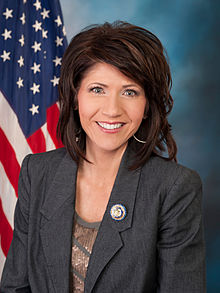
 Kristi Noem, congresswoman from South Dakota, was in Chicago last week. She took the time to have a coffee with more than 20 women from the Chicagoland Policy Circles. Here are some of the insights she shared.
“Borrowing to pay the Death Tax got me in politics”
Kristi’s dad was killed in an accident on the family ranch while Kristi was in college. She came home to run the family business, and was faced with borrowing $1 million dollar to pay the death tax to keep the family business. She decided that business women like her had to get involved and be influential. Kristi ran and won a State Senate seat, which meets only once a year for 40 days (we all sighted of surprise, wishing it was this way in Illinois).
In 2010, she was asked to run for Congress, and has been the sole house representative from South Dakota ever since (Civics class reminder: each state sends representatives based on their population – Connecticut sends 8 representatives).
Networking, networking
At the Policy Circle Summit, Erin Wolf gave a workshop on networking and relationship building, and using your network to advance toward your goals. Kristi shared that South Dakota only has one representative, which means that she was not part of a delegation. She joined the House of Representatives alone, so she had no choice but build relationships with all the other representatives as soon as she arrived. What could have been perceived as a disadvantage was actually an edge – Kristi was nominated representative for her freshman Class of 2010 (yes you are reading this right, it is like college – everything works on seniority in the House). She was also invited to be on the advisory council for the House Speaker, because she knew everyone.
Getting where you want to be
Representatives try to get on committees that impact their constituency (brush up on How the House of Representatives work with The Policy Circle Brief). Therefore it is typical for the South Dakota representative to be on the Agriculture Committee. That committee works on a farm bill every 5 year. After having done that, Kristi realized that the next big thing was going to be Tax Reform so she pushed to be on House Ways and Means Committee. (You read that right, she did not wait politely to be asked, she raised her had and networked with a purpose).
The Committee on Ways and Means is the oldest committee of the United States Congress, and is the chief tax-writing committee in the House of Representatives. The Committee derives a large share of its jurisdiction from Article I, Section VII of the U.S. Constitution, which declares, “All Bills for raising Revenue shall originate in the House of Representatives.” To be on that committee you need to present a file that makes your case:
– What expertise are you bringing to the table? (Kristi worked on tax reform in South Dakota where there are no income tax)
– Are you a team player? Show that you are willing to travel to support your colleagues (read fundraise)
– Who can vouch for you? Have the support of members of the steering committee (back to networking)
House Ways and Means Committee vs. the Office of Management Bureau
The House and Ways Committee develops policy reforms and presents the bills to be voted on by the senate, like the Tax Reform. The agencies like the IRS implement the bill. Mick Mulvaney, director of the Office of Management Bureau (OMB), shared at the Policy Circle Summit that OMB is responsible for holding accountable the government agencies that implement the bills approved by Congress.
So, OMB asks verifies the costs and results of the implementation by the agency.
No Sleep for the Restless
The House Ways and Means committee meets 5 times a week, sometimes multiple times a day. They are now working on Tax Reform 2.0. Kristi shared how they run from their office, to committees to the Capitol to vote on bills relying heavily on staffers. When the Congress is in session, it’s 20 hour days.
Share your passion with DC Staffers
There were several questions on how do we hold the agencies accountable for efficiency and quality of the service that deliver – fraud on entitlements was brought up. Kristi shared that each of us should call the DC office of our representatives and share our passion for an accountability issue with the staffer who answers the phone.
Kristi gave the example that she received several calls from concerned constituents about the IRS re-hiring employees who had been fired for misconduct (sharing personal information of taxpayers, stealing from the IRS etc.)
She proposed a bill, titled titled the Ensuring Integrity in the IRS Workforce Act, that would prevent the IRS from rehiring employees fired for misconduct or poor performance. She would not have known about this issue without her constituency pointing it out to her. She also said that if your representative is not being responsive, you should ask a family member or friend to ask their representative to ping your representative. That’s the power of The Policy Circle network: you know someone in every almost every state.
We heard at The Policy Circle Summit, the director of the Office of Management Bureau present the plan to merge the Secretary of Education and Labor, so that education policies open career pathways. If you care about this initiative, let your representative know. It does not matter which party they are on, once they are elected they represent each of us.
Having a goal – what is next?
Term limiting herself, her goal was to stay for 10 years, so in 2018 she is not seeking re-election to Congress. She is returning to South Dakota by running for Governor to address major issues in her state: reforming higher education to open career pathways for young people in South Dakota, developing cyber security industry (South Dakota university is developing a center of excellence), and helping people with drug addiction.
We noticed…
In our conversation, Kristi never said that being a woman was a disadvantage, she never talked about “women” issues… because all issues are women issues.
Suggested questions when inviting an elected official to your Policy Circle meeting
To make the conversation productive and informative, it is helpful to have a series of questions prepared centered around the committees that they serve on and their leadership skills.
Here are the questions we asked before opening the floor:
- What pulled you into becoming a policy maker? (career trajectory)
- Why and How did you get on the House Ways and Means Committee? (learn about committees)
- How does the House Ways and Means Committee interact with the Office of Management Bureau? (always a good tie to government accountability)
- How important is networking? (tie to leadership we could also ask what is your brand on Capitol Hill)
- How should constituent interact with you and your office? (how to we know what’s going on)
- What is your reaction to the idea of merging Education and Labour? (tie to government efficiency – look at performance.gov)
What is next? (tie to having a career and policy goal)
It’s a movement!
Recommend a Circle Leader. Especially in Georgia, California, Wisconsin, and Michigan, Kansas and Arizona where circles are sprouting.
Start a Circle in your community. Your community may be your profession or your neighborhood, or both. The Policy Circle is a simple way to practice the language of leaders with the facts and the space to be at ease with weighing in on the impact of policy.
Invest in The Policy Circle. Together let’s build a network of women who want to be part of the dialogue on the impact of policy in their lives.
The Policy Circle is a 501(c)3 that provides a fact-based, nonpartisan framework built to inspire women living in the same community to connect, learn about and discuss economic policies that impact their lives. Women across the nation are taking a leadership role in the public policy dialogue on what human creativity can accomplish in an open economy.


