
Human trafficking is one of the most pervasive human rights issues facing communities today. While the crime often feels distant or hidden, it exists in cities and towns across the country. The Marco Island Policy Circle demonstrates how local conversations, grounded in policy and strengthened by community expertise, can help turn awareness of human trafficking into informed action.
When the Marco Island Policy Circle, led by co-founder of The Policy Circle Angela Braly, chose to focus on human trafficking, they started with a discussion of The Policy Circle’s Human Trafficking Brief. This initial conversation provided a shared foundation, helping Circle members better understand how trafficking operates, why it persists, and which populations are most vulnerable.
But the Circle also recognized that truly understanding human trafficking requires more than reading and discussion alone.
DEEPENING THEIR UNDERSTANDING OF HUMAN TRAFFICKING
To broaden their understanding of human trafficking and survivor support, the Marco Island Policy Circle welcomed Renee Pollino, Founder of My Half of the Sky Coffee House, to speak about employing trafficking survivors. My Half of the Sky is a social enterprise and mission-driven coffee shop that uses the marketplace as a tool for positive social impact. It prioritizes opportunity and dignity for individuals facing obstacles to employment, including survivors of human trafficking. My Half of the Sky aims to provide marginalized people with meaningful work and support on the path to self-sufficiency and hope.
This conversation helped the Circle move beyond awareness and into a deeper understanding of survivor-centered solutions, connecting policy concepts to real-world impact.
EXPANDING THE CONVERSATION THROUGH COMMUNITY LEADERSHIP
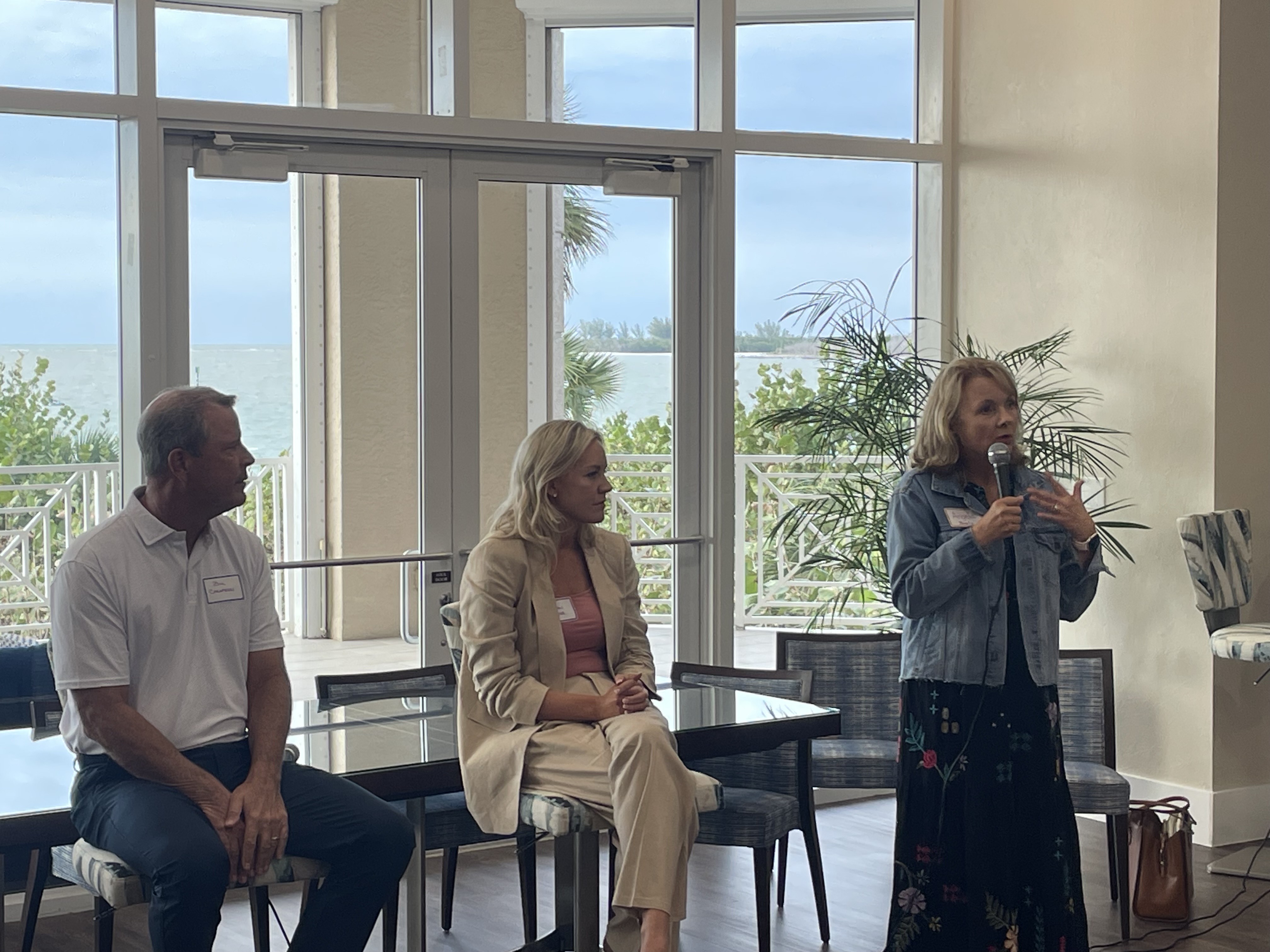
As their understanding grew, the Marco Island Policy Circle broadened the conversation by hosting a community panel to raise awareness on human trafficking. The panel featured local leaders working on the issue from different perspectives, including Collier County Sheriff Kevin Rambosk, Marco Island Police Chief Linda Frazzano, and Linda Oberhaus, CEO of the Shelter for Abused Women & Children.
The Collier County Sheriff’s Department and Marco Island Police Department have vocalized their commitment to combating human trafficking. Both departments are part of a Southwest Florida INTERCEPT Task Force, working together with state and federal law enforcement to combat human trafficking. The Shelter for Abused Women & Children offers emergency shelter, transitional living cottages, and other support programs for victims of domestic violence and human trafficking.
Collaboration between law enforcement, service providers, and community members is essential to prevention and response. By bringing together experts from across sectors, the Circle gained a more comprehensive view of the issue.
TURNING AWARENESS INTO ACTION THROUGH SERVICE
Rather than letting the conversation end, the Marco Island Policy Circle chose to put their learning into action.
The Circle partnered with Path2Freedom’s Magnolia House, a safe house for child survivors. The organization is dedicated to providing long-term care and stability for children who have been trafficked. The Circle members volunteered their time and resources to assemble cozy bedrooms for residents. This service project reflected a key takeaway from the Circle’s conversations: informed communities can play a meaningful role in addressing human trafficking when learning is paired with action.

A MODEL FOR CIRCLES SEEKING IMPACT
The Marco Island Policy Circle’s experience demonstrates how Circles can move beyond conversation to become catalysts for change. By engaging community experts and remaining open to learning, the Circle transformed awareness into action and showed how local efforts can contribute to the broader fight against human trafficking.
HOW YOUR POLICY CIRCLE CAN TAKE THE NEXT STEP
- Begin with a policy-based discussion on human trafficking
- Invite speakers with lived experience or subject-matter expertise
- Engage local leaders to understand the issue at the community level
- Identify one tangible action or service opportunity


