
The Active Voter Guide
Your voice and your vote matter in every election. Every American citizen has a duty to actively participate in the election process. The first step i…
Read

POLICY INSIGHT
Listen to The Trust Your Voice Podcast for an audio version of this guide.
Make a plan to vote! Talk to your community and gather a group to go to your polling place on Election Day. Find out where to vote by looking up your polling location. Ask your employer if they provide time off to vote. In Texas, for instance, state law mandates that employees get time off to vote. See if your state does the same here.
If you’re not registered, there are many resources to help you. See The Policy Circle’s First-Time Voter Handbook for information about registering and checking your state’s voting requirements
As an active voter, you may be asking what races are taking place that could impact the future of your city or state. Check out Ballotpedia’s Elections Calendar for detailed information on statewide and local elections. This resource will also help you find out what and who is on your ballot.
It’s likely that you will also have the opportunity to vote on ballot measures. An excellent first step is to categorize the type of measure on your ballot. While all 50 states allow for ballot measures of some kind, not all allow for every type of measure.
Ballotpedia’s election calendar is a great place to start researching the content of the measures in your election. Groups lead some measures — if you notice this, follow up with the organization to understand their reasoning and rationale for the measure. If the measure is connected to a specific issue, search The Policy Circle’s Brief Library to see if one of the 60+ briefs covers the issue.
Once you know who is on your ballot and the offices they seek, you can do your due diligence to make your vote as informed as possible. This section covers the essentials. For a full method, including how to read a candidate’s website and social media, how to weigh qualifications against character, and questions to put to a candidate directly, see The Policy Circle’s Assessing Candidates Guide.
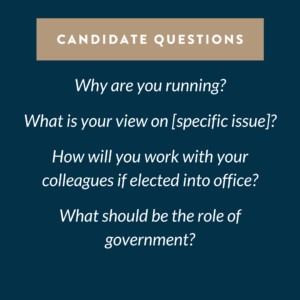
Start with party. Identify which party a candidate is affiliated with and read that party’s platform, since it is often the single best predictor of how a candidate will vote once in office. You can compare the national platforms side by side on Ballotpedia, or read them at the source on the Republican and Democratic party websites. Each state party publishes its own platform as well. Then look at the candidate as an individual: research their voting record if they have held office (federal or state), their previous government or community service, and their endorsements. Do a news search to see how they have been covered across a range of outlets, not only the ones you usually read.
If you still have questions after doing your research, reach out. Local candidates in particular are often willing to answer an email or meet a constituent for coffee.
Finally, pull your research together before you decide. Your sample ballot and your secretary of state’s official candidate listings let you see the full slate for your address in one place, so you can compare everyone on the ballot before you vote.
Money is the fuel of modern campaigns, and there is rarely enough of it. Federal Election Commission filings show that in just the first fifteen months of the 2026 cycle, congressional candidates raised $2.1 billion and political action committees took in $6.3 billion. Consider Alabama’s Robert Aderholt, whose district is about as safe as they come: in 2024 he still had to bring in around $1.5 million to hold it. Lower on the ballot, the picture is the same. The cost of running scales with the office. A campaign for a local seat, such as school board or city council, can be run competitively on anywhere from a few hundred dollars to a few tens of thousands, while a state legislative race more typically climbs from the high tens of thousands into the hundreds of thousands, and higher still in large or hotly contested districts, according to 2026 estimates from GoodParty.org. Behind these totals sits the reality that staff, travel, signs, mailers, and advertising all cost money, and a candidate who cannot pay for them struggles to be heard, however capable they may be.
When you give to a campaign, whether you give money or give your time, you become invested in the outcome in a way that a vote alone does not capture. Contributing is also a form of speech: the Supreme Court has recognized political giving as an expression of your First Amendment rights, a way to say publicly that a candidate, or a cause, is worth supporting. And your time can be worth as much as your money. The candidates who need help most, those in local races that draw little outside funding, are often the ones where a handful of committed volunteers changes the result.
There are several ways to contribute, and it helps to understand the distinctions before you give:
These mechanisms work differently and are regulated differently. The Policy Circle’s Campaign Finance Deep Dive walks through how each one works and where the money goes.
Federal law sets limits on how much you may contribute and to whom. For the 2025-2026 cycle, an individual may give up to $3,500 per election directly to a federal candidate, with separate limits for party committees and PACs, while super PACs may accept unlimited amounts. The Federal Election Commission lays out these limits, along with the rules on volunteering, hosting events, and disclosure. State and local races follow separate rules that vary from state to state, including their own contribution caps and disclosure thresholds, so check your state’s election board or secretary of state before giving in a state or local race. Contributions above certain amounts are publicly reported, so assume that any political donation becomes part of the public record.
Most campaigns welcome volunteer support and rely on them to be as effective as possible. If you find a candidate you are passionate about supporting, contact them to learn about their needs and ways you can help. Showing your support can be as simple as displaying a yard sign. Other examples include hosting a meet and greet for your friends and neighbors, door-to-door canvassing, or making calls encouraging people to vote. Most candidates will have volunteer or contact information on their websites. If not, consider checking with the political party or connecting with the local chapter.
Finally, connect with your local election office to get involved in the election process if you do not feel compelled to promote one specific candidate.
Besides voting, one of the most direct ways you can participate in elections is by serving as a poll worker, also called an election official or election judge. At a polling location, you can help verify that election rules are followed, ensure the integrity of the results, and certify that all eligible voters have the opportunity to do so.
By volunteering your time and resources to make elections free and fair, you are serving your community, state, and country. It’s a great way to engage in your community, interact with voters and the voting process, and significantly impact the outcome of an election by reducing fraud.
You can also bring a friend to make the day more enjoyable. Many polling locations house multiple precincts; two friends can easily make a significant impact. Your firsthand involvement with the electoral process will set an example for others around you and inspire their participation. This will only help grow the number of active and involved citizens and ensure free and fair elections as envisioned by our Founders and enshrined in our Constitution.
Poll workers receive training specific to their county or municipality. Still, all poll workers are generally responsible for administering election procedures at the polling place on Election Day. These duties include:
To serve as a poll worker, you must meet the eligibility requirements in your state. Most states generally require the following:
Be sure to check your specific state’s requirements.
The polls on Election Day are busy, and workers are usually paid for their time. To become a poll worker, find your state’s specific information and contact information for your state and local election offices at Work Elections, the National Association of Secretaries of State, or this State Election Authorities list.

Poll watchers monitor election procedures to ensure compliance with the law. The ultimate goal is to hold fair elections that report accurate election results. Poll watchers differ from poll workers and election officials in that they have no legal authority in the polling location and are strictly prohibited from touching any ballots or other voting equipment.
Poll watching is a voluntary position that involves observing elections and reporting any irregularities at the polling place. Thus, poll watchers help ensure the free and fair conduct of elections. Many times, their mere presence is enough to deter fraud. Reaching a legitimate, fair outcome requires following the law for every vote cast.
Political parties, candidates, and proponents of ballot initiatives can appoint partisan poll watchers, and nonpartisan organizations can appoint nonpartisan poll watchers to observe elections. Importantly, poll watchers do not interfere with anyone’s right to vote.
Poll watchers are responsible for observing the following:
The qualifications of poll watchers vary from state to state. Some states do not require poll watchers to be state residents; others require poll watchers to be registered voters in the county they serve. See this list for more information on your state’s qualifications.
To become a poll watcher, contact the campaign, political party, or organization of your choice regarding your willingness to serve for all or part of a day. They will be grateful and will guide you through the process. If you cannot contact them, contact the election authorities for your state.
Voting and volunteering in the election process is an effective way to create meaningful change in both your country and your local community. The United States is built on the belief that every individual matters and has something to contribute; local, state, and federal elections are a way to communicate what you believe your community needs more of. The more Americans who vote and get involved with the election process, the more our country can reflect its citizens’ needs and desires and embrace every individual’s voice.
Update The Policy Circle – We want to know about your civic engagement! Invite friends, take pictures, and send updates to us at [email protected].
Keep learning about elections! Visit The Policy Circle’s Election Webpage to explore more resources and investigate a variety of topics.


The Policy Circle is a nonpartisan, national 501(c)(3) that informs, equips, and connects women to be more impactful citizens.